Madrid Bear and Strawberry Tree: The Coat of Arms and the Sol Statue
Madrid's bear and strawberry tree date from the 13th century and a dispute over pastures and trees. How the shield changed and where the Sol statue stands.
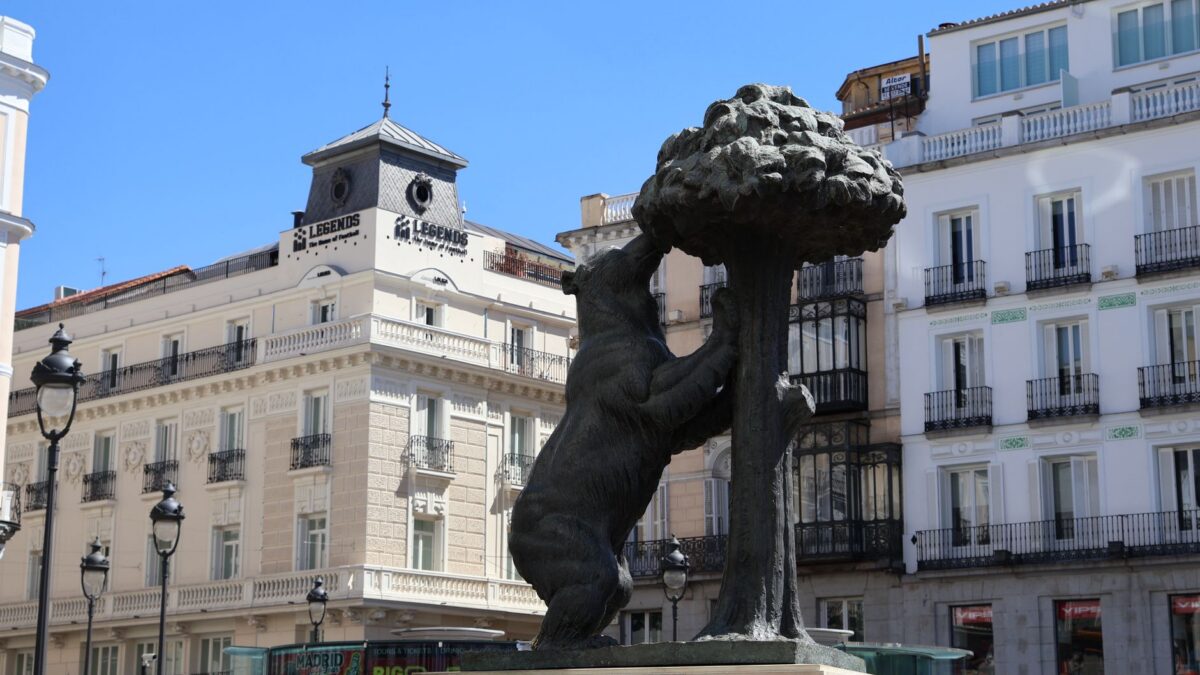
The bear and the strawberry tree on Madrid’s coat of arms go back to the Middle Ages. The bear came first, on the banners of the town’s militias, and the tree was added after a 13th-century dispute between the town council and the clergy over who controlled the land around Madrid. Since Jan. 19, 1967, the same pair has stood as a statue of stone and bronze in the Puerta del Sol, the square at the center of the old city.
Where did the bear on Madrid’s shield come from?
The bear is the oldest part of the arms. According to medieval chronicles summarized on the Wikipedia page on the coat of arms of Madrid, the militias of the council of Madrid fought in several battles of the early 13th century under a banner showing a black bear on a white field.
In 1212 the council used an ensign with a bear and the seven stars of the Ursa Major or Ursa Minor, the constellations named after bears. Madrid’s troops carried that flag at the Battle of Las Navas de Tolosa. On this early version the bear walks on all four legs.
Why does the bear lean on a tree?
The tree arrived through a lawsuit. In the early 13th century the cabildo (the chapter of clergy) and the municipal council argued over the fodder in the fields and forests of El Real de Manzanares, north of the city. In 1222 the dispute was settled: the pastures went to the clergy and the trees went to the council.
After that, the council’s bear stood up on its hind legs and leaned on a tree, reaching for its fruit. The change probably signalled that the council controlled the timber. The clergy’s bear, on the cabildo’s own emblems, kept walking on all fours.
Why the tree became a strawberry tree (Arbutus unedo, madroño in Spanish) is less clear. Historians have suggested a mix-up between the Latin words Arbutus and Arbustus (shrub), or a wish to make the design more colorful, since the species was probably never common around Madrid. A recent study by the heraldist Dario Scaricamazza argues that the madroño was chosen partly because its name sounds like the name of the city (a pun known in heraldry as canting arms), while the bear has no such link. He calls Madrid’s shield semi-canting.
How did the coat of arms change over the centuries?
The basic picture of a bear, a tree and seven stars on a blue border has stayed in place since 1222. Crowns, stars and extra figures came and went with Spain’s political history:
- 1222 to 1544: the bear stands rampant to eat from the tree, and the seven eight-pointed stars sit on a blue border.
- 1544: Charles I gave Madrid the titles of “Imperial” and “Crowned,” so a crown was placed above the tree.
- 17th century: an open Spanish royal crown was set on top of the shield. Around 1650 the stars were rearranged.
- 1859: a golden griffin and a civic crown were added. The Cortes (Spain’s parliament) awarded the civic crown for the people of Madrid’s resistance to the French occupation in 1808. The stars became five-pointed and the royal crown closed. The Wikipedia text also gives 1822 as the year the council adopted the griffin and civic crown, so the sources differ on the date.
- First and Second Republics: a mural crown, shaped like city walls, replaced the royal crown.
- 1939 to 1967: under Franco the stars became six-pointed and the regime’s heraldic open crown was used.
- 1967: the griffin and the civic crown were removed.
- 1982: the older open royal crown returned and the design was simplified.
The griffin had a local origin. A dragon or serpent, depending on the account, was carved on the keystone of Puerta Cerrada, also called Puerta de la Sierpe (Serpent Gate), one of the gates in Madrid’s old walls. A fire destroyed the gate in 1582 and it was never rebuilt, but the serpent stayed an informal symbol of the city until the 19th century, when the dragon was put on the arms and soon turned into a griffin. Our guide to how Madrid began and the walls that still survive covers that older city.
What does the shield look like today?
In heraldic terms, the shield is silver with a black bear standing against a green strawberry tree with red fruit, inside a blue border with seven silver stars. Above it sits a large open royal crown of gold and precious stones, with eight rosettes (five of them visible) between eight pearls. This type of crown is common on Spanish municipal and regional arms.
The same bear, tree and seven stars also appear on the badge of Atlético Madrid, the city’s football club.
The shield had a wartime role as well. In March 1938, after the Battle of Cape Palos, the largest naval battle of the Spanish Civil War, the Second Republic gave its Distintivo de Madrid award for courage to the cruisers Libertad and Méndez Núñez and the destroyers Lepanto, Almirante Antequera and Sánchez Barcáiztegui. Their crews then wore a badge with Madrid’s coat of arms on their uniforms.
The statue of El Oso y el Madroño in Sol
The statue of the Bear and the Strawberry Tree (El Oso y el Madroño) is the coat of arms turned into a life-size sculpture. The culture section of the Ayuntamiento de Madrid (Madrid City Council) commissioned it to put the city’s main heraldic symbols into a monument. The sculptor was Antonio Navarro Santafé (1906-1983).
The statue is made of stone and bronze, stands 4 metres (13 ft) tall and weighs about 22 tons (20 tonnes). It rests on a stepped granite pedestal. As on the shield, the tree is taller than the bear, which props its paws on the trunk and looks up at one of the fruits.
Why has it moved?
The statue has always stood in the Puerta del Sol, but in two spots. It was first placed on the east side of the square, between Calle de Alcalá and Carrera de San Jerónimo. In 1986 a remodelling of the square under mayor Enrique Tierno Galván moved it to the front of Calle del Carmen. In September 2009, during a full renovation of Sol promoted by Alberto Ruiz-Gallardón, it went back to the east side, where it stands today.
Tips for visiting
- Look for the statue on the east side of the Puerta del Sol, between Calle de Alcalá and Carrera de San Jerónimo. It is a common meeting point, so expect a crowd around it.
- The bear’s tail and heel are discolored because visitors rub them for luck. The habit copies similar statues elsewhere in the world; there is no historical record of it as a Madrid tradition.
- The Wikipedia article on the arms lists other versions you can find in the city: a carved shield on the Casa del Pastor in Calle de Segovia, described as the oldest in Madrid, and the historic arms on the Alcachofa Fountain in Retiro Park. Both fit into a walk around free things to do in Madrid.
Quick answers
What do the seven stars on Madrid’s coat of arms mean?
They appeared on the council’s flag in 1212 as the seven stars of the Ursa Major or Ursa Minor, the “bear” constellations, matching the bear on the banner.
When was the statue in Sol unveiled?
It was inaugurated on Jan. 19, 1967. It is the work of Antonio Navarro Santafé.
Is the bear male or female?
The Scaricamazza study refers to the animal as a she-bear. Most descriptions, including those of the statue, simply call it a bear.
Why is Madrid’s crown different from the one on older shields?
In 1982 the city dropped the heraldic crown used under Franco and went back to the older open royal crown.
Checked against official sources in November 2026. Hours, prices and rules change: confirm on the official page before you go or apply.